Cable repair
Wraparound cable repair sleeve, closed on an energised run
The sheath is torn, the feeder will not come off load, and the repair has to close from the side.
Water is inside the sheath within hours of the damage. It does not stay at the wound.
It travels under the jacket along the length of the run. It reaches the metallic screen and corrodes it in patches. A screen that has gone high-resistance in patches no longer carries fault current the way the design assumed. The cable then fails weeks or months later, often several metres from the original damage, and the fault locator sends a crew to the wrong pit.
So the clock starts at the moment the jacket opens, not at the moment the circuit trips. And you cannot take the run out of service to deal with it.
That is the whole case for a wraparound. It is folded round the run in situ, closed along one seam, and recovered onto the damaged length. Nothing is cut and nothing is disconnected. The manufacturer states plainly that a shutdown is not required to fit one.
Two code families do this job and they close by different means. Insulsleeve, coded GWS, zips onto a stainless steel channel that runs the length of the seam. The GMRS repair sleeve is taped along the seam with heat-resistant tape and then shrunk. Both families are cross-linked polyolefin over a hot-melt lining. In both, the adhesive makes the seal and the polyolefin only holds it there.
Insulsleeve GWS and GMRS wraparound cable repair sleeve
A cross-linked polyolefin sleeve, hot-melt lined, closed along a seam and recovered onto a damaged jacket without cutting the cable or dropping the load. Manufactured by Gala Thermo Shrink Pvt. Ltd.
- Fits without disconnecting the cable or taking the circuit off load
- Hot-melt adhesive gives the environmental seal, the polyolefin gives the mechanical wall
- Flame retardant and self-extinguishing
- Resists UV, chemicals, copper corrosion and fungus
- A handful of stocked sizes covers most repair diameters on a distribution network
| Material | Cross-linked polyolefin |
|---|---|
| Closure, GWS | Zip-up stainless steel channel |
| Closure, GMRS | Heat-resistant tape along the seam |
| Shrink ratio, GMRS | 3:1 |
| Seal | Hot-melt adhesive lining, sealed to IP68 |
| Recovered wall, GWS | 2.7 mm on every code in the range |
| Code range | GWS-55/8 to GWS-240/50 and GMRS-19 to GMRS-250 |
| Cable OD, GMRS chart | 5 mm to 192 mm |
| Supplied lengths, GMRS | 100, 200, 300 and 400 mm by code |
| Maximum length, GWS | Up to 1500 mm |
| Minimum overlap, GMRS | 25 mm to 75 mm, stepping with code size |
| Recovery indicator | Temperature-sensitive paint that changes colour |
| Custom dimensions | Available on request |
Where this is the wrong part
Settle this before the requisition goes in, not after the sleeve is on the cable.
- Damage that reaches past the jacket. If the insulation, the semi-conducting screen or the conductor itself is broken into, you need a joint. A repair sleeve restores the jacket and nothing beneath it.
- A bare overhead conductor. Recovering a sleeve over bare line gives you no touch-safe rating, and none is published for these codes. The sourced part of that problem is on repairing distribution cable and conductor.
- A steel pipeline weld joint. That takes the three-layer sleeve, a separate closure patch and a cathodic disbondment result. Different substrate, different chart: see the pipeline corrosion protection sleeve.
- A free cable end you can still thread a tube onto. A seam you did not need is a seam that can leak. Wraparound or tubular settles that in one question.
- Anything outside 5 mm to 192 mm cable OD on the published GMRS chart, unless a custom size has been agreed in writing first.
- A specification that must name a voltage class. These sheets publish dielectric strength per millimetre of wall. That is a material property, not a cable voltage rating, and the two are not interchangeable.
Not published — get it in writing
The wrap-around sheet carries no recovery temperature, no adhesive softening point, no peel strength and no voltage class for GWS or GMRS. There is also a trap on the printed sheet itself. The technical specification table sits in the Insulcap end cap column, under the GEC selection chart, and its figures belong to that cap. They contradict the repair sleeve's own published values in three places at once: 12 kV/mm against above 15 kV/mm, dielectric constant 5 against 3.0 maximum, and -40 to +100 °C against -55 to +125 °C. Do not lift a shrink temperature or a dielectric figure off that table and attach it to a sleeve. Ask the manufacturer for the sleeve's own numbers before a specification cites them.
Published properties of the repair sleeve
| Property | Value | Method |
|---|---|---|
| Tensile strength | 12 N/mm² minimum | ASTM D638 |
| Ultimate elongation | 300% minimum | ASTM D638 |
| Specific gravity | 1.4 | ASTM D792 |
| Dielectric strength | Above 15 kV/mm | ASTM D2671 |
| Dielectric constant | 3.0 maximum | ASTM D150 |
| Operating temperature, outer wall | -55 °C to +125 °C | IEC 216 |
| Heat shock, 250 °C for 4 hours | No dripping, cracking or flowing | Not stated |
| Fungus resistance | Inert | MIL-I-7444 |
| Flammability | Flame retardant, self-extinguishing | Not stated |
| Environmental seal | IP68, from the hot-melt lining | Not stated |
As published for the heat shrink cable repair sleeve. Where the sheet gives no test method the column says so, rather than borrowing one from a neighbouring product.
The seam is the part that fails
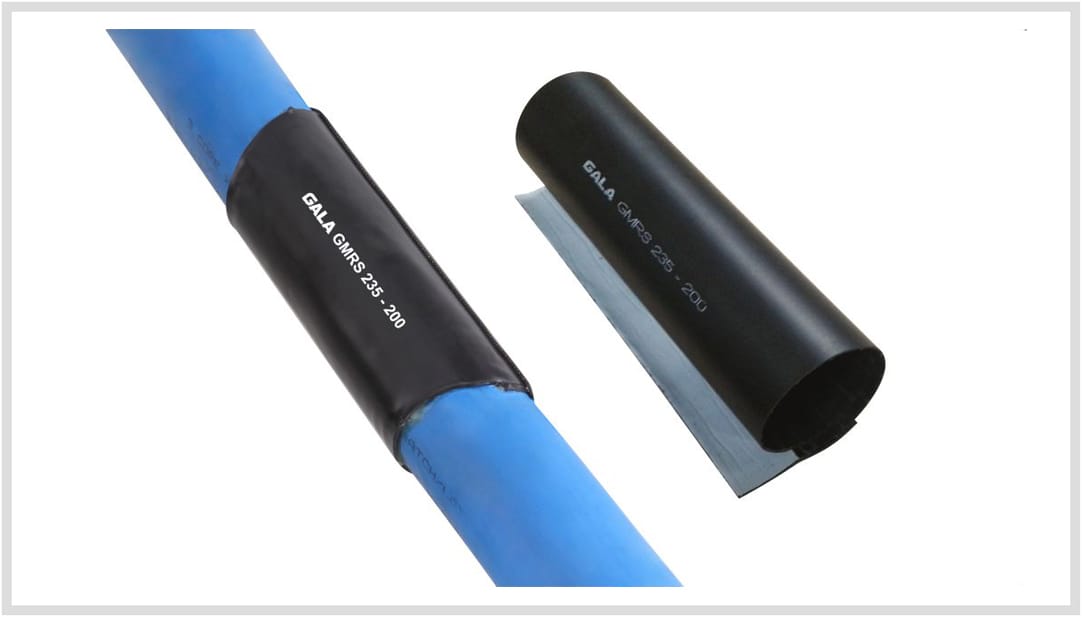
Look at the flat sleeve in the manufacturer's photograph. The grey inner face is the hot-melt lining, and the tongue running out past the roll is the overlap. That tongue is the entire repair. Everything else is a tube that has already worked a thousand times.
Overlap steps with size on the GMRS chart. The published minimum is 25 mm up to GMRS-70, 50 mm at GMRS-115 and GMRS-160, and 75 mm from GMRS-180 upward. It is a minimum on a sleeve cut to a circumference, so a cable sitting at the small end of its band gives you more overlap than the chart promises, and one sitting at the top end gives you exactly the minimum and no margin.
Neither sheet says where to index the seam around the cable, so this part is judgement rather than instruction. Keep it off the face that takes the drag in a duct pull, and off the underside where backfill stone bears on a direct-buried run. Put the seam where nothing is pressing on it.
The pipeline sleeve solves the same seam a different way. Each three-layer sleeve is supplied with a separate closure patch that is shrunk over the joint after the sleeve is wrapped, so the closure is a second component. The cable sleeve carries its closure with it: a stainless channel on GWS, heat-resistant tape on GMRS. That is why a GWS sleeve can be closed one-handed on a cable that is still live and a pipeline sleeve cannot.
A temperature-sensitive paint on the sleeve turns colour once recovery has finished, and that is the whole of what it reports. It confirms the outer wall reached shrink temperature. It says nothing about whether the adhesive wetted out underneath. Judge that on the bead: a continuous line of melted hot-melt squeezed out at both ends and along the overlap. No bead, no seal, whatever colour the paint has gone.
Before you fit one
- Heat shrink sleeve size chartEvery GWS and GMRS row, with recovered walls, cable bands and the overlap column
- How to install a wraparound heat shrink sleeveSurface preparation, torch discipline and the order the seam closes in
- Why wraparound sleeve repairs fail in the groundWhat excavated failures look like once the seam has let go
- Wraparound or tubularOne question decides which family the job needs
- Reading a heat shrink datasheet without taking it on trustWhat ASTM D2671, ASTM D638 and IEC 216 actually measure
Send the cable, not the code
Give the cable outer diameter in millimetres, the damaged length, the jacket material and the ambient temperature at installation. A size comes back in one reply instead of four.