Cable · pipeline · pole · pipe support · tape
Sleeves that close around what you cannot take out
Water gets into a split jacket. A weld joint corrodes under backfill. A pole rusts through at grade. None of it can be taken out to be repaired. So this site covers one thing: parts that close around an asset already standing, buried or live. Tubing sold by the metre, jointing and termination kits, cold shrink, busbar sleeving and pole caps are not here.
- The part arrives open along its whole length. You fold it round the substrate, close the seam with a stainless steel channel or an adhesive patch, and only then apply heat.
- Size it on the substrate, never on the damage. Cable outer diameter picks GWS and GMRS. Pipeline outer diameter picks GTWS. Pole outer diameter picks GPWS.
- Gala Thermo Shrink Pvt. Ltd. makes every part named on this site, at Palghar in Maharashtra and at the Surat SEZ. The Overlap indexes and explains them.
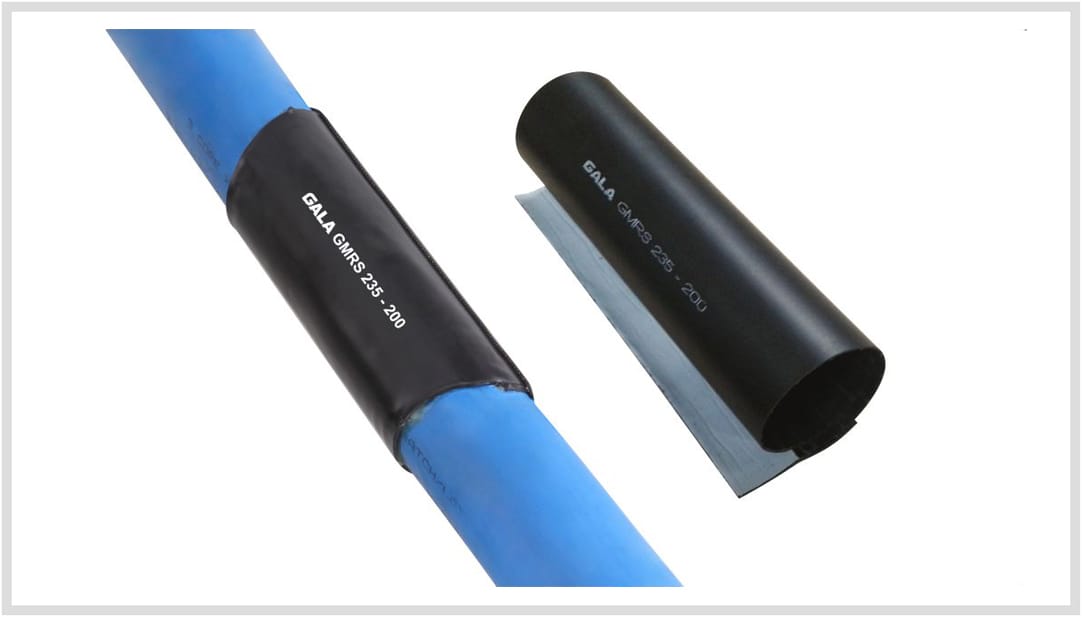
The part is defined by its seam
A wraparound is a sleeve slit down its length before it ever reaches site. It goes round the cable, the pipe or the pole, and the two long edges are brought together and held. On the GWS cable range the closure is a stainless steel channel zipped over a moulded rail. On GTWS pipeline sleeves it is a separate closure patch, 100 mm long on a Ø159 pipe and 200 mm long on a Ø1016. On GMRS the wrap is held with heat-resistant tape. The heat goes on last, and the seam is the only part of the repair that did not exist before you made it.
A tube cannot do this. It has to be threaded over a free end, which means finding one, cutting one, or taking the run out of service to make one. That single question settles the part type before any code matters, and it is worked through on wraparound or tubular.
Where the two edges meet they lap over each other, and the lap is a stated minimum rather than a preference. Across the GMRS repair range it steps in three bands: 25 mm minimum up to GMRS-40, 50 mm at GMRS-115 and GMRS-160, and 75 mm from GMRS-180 upward. GPWS pole sleeves step the same way, 50 mm minimum on GPWS-502 and 75 mm on every larger code. It is the only column on those charts that describes the closure rather than the substrate.
So measure before you order, and measure the thing you are wrapping rather than the wound in it. A jacket split 40 mm long on a 60 mm cable is a 60 mm order. Diameter picks the code; length is chosen separately, from the stocked lengths against that code. Both columns sit on the heat shrink sleeve size chart. The parts themselves are the manufacturer's, and its own page for the zipped cable sleeve is Insulsleeve.
Two charts, and the diameter decides which
One number routes you: the outer diameter of what you are wrapping. Cable dimensions and pipeline dimensions are held on separate pages here and neither restates the other.
| What you measured | Published range | Codes | Chart to open |
|---|---|---|---|
| Cable or jacket outer diameter | 5 to 192 mm | GMRS-19 to GMRS-250. GWS-55/8 to GWS-240/50 is charted on supplied diameter instead. | Heat shrink sleeve size chart |
| Steel pipeline outer diameter at a field weld | 159 to 1016 mm | GTWS Ø159 x 500 to GTWS Ø1016 x 500 | Pipeline sleeve size chart |
The range on one screen
Nine families, and the code prefix tells you which substrate it was drawn for.
GWS — zipped shut with steel
Folded round a cable or pipe jacket and zipped with a stainless steel channel. Supplied diameters 55 to 240 mm at a 2.7 mm recovered wall, in lengths to 1500 mm. A temperature-sensitive paint changes colour once the shrink is complete, so the seal is confirmed on sight.
GMRS — taped, then shrunk
The repair grade for a damaged jacket or a covered connector on a run that stays live. Shrink ratio 3:1, hot-melt adhesive sealed to IP68, flame retardant and self-extinguishing. Outer wall service temperature runs -55 °C to +125 °C. The method is IEC 216.
GTWS — three layers on a field joint
Cross-linked polyethylene over hot-melt adhesive, bonded across the bare weld onto the pipe's own PE coating. Ø159 to Ø1016 mm at 500 mm width, each size supplied with its closure patch. Cathodic disbondment is 3 rad. The method is ISO 21809-3.
GPWS — the pole at ground line
Wrapped round a pole that is already standing and used together with epoxy paint on steel, concrete or composite. Pole outer diameter 70 to 360 mm, 700 mm long, cuttable to size in the field. Published service life is more than 30 years.
GPPC1 and GPPC2 — pre-insulated pipe outlets
Heat-shrink caps with a hot-melt or mastic lining that close the casing over the joint on pre-insulated pipe. GPPC1 is single outlet, 60 to 570 mm supplied internal diameter. GPPC2 is double outlet, 115 to 355 mm. Adhesion is 14 N/cm minimum. The method is ISO 21809-3.
GMW couplers — corrugated HDPE joined in place
A tube rather than a wrap, so one pipe end still has to be free. A 3:1 shrink ratio carries GMW 70/22 to GMW 863/250 on few stocked sizes, with a hot-melt lining sealed to IP68. It stands in for butt welding, a snap-fit coupler or a split coupler.
GMWR and GHWR — over the U-bolt shank
Also a tube, and the one part here that goes on a fastener rather than round the line. What corrodes is the U-bolt and pipe contact point, and the pipe stays clamped throughout. GMWR medium wall covers 9/3 to 50/16, GHWR heavy wall 12/3 to 50/16.
GMT — tape for a bend
Wound onto geometry no tube will thread onto: a bend, a set, an irregular section. The shrink squeezes its adhesive into surface irregularities as it conforms. GMT-2L is 50 mm minimum roll width, 15 m minimum roll length, 1.0 mm ± 0.10 thick. Halogen-free and anti-tracking.
HBMT and HRMT — mastic, worked in cold
Butyl sealant pressed into what a sleeve cannot bridge: a step, a screen cut, the shoulder of a lug. Black HBMT is 35 mm minimum width at 2.5 mm thick, from 100 mm strips to 25 m rolls. Red HRMT is 35 mm wide at 2.0 or 1.7 mm. Neither shrinks.
GNT — insulation built by hand
An EPR tape wrapped half-lapped, layer on layer, until the required build-up is reached on XLPE, PVC, PILC and rubber-sheathed jackets. Cold flow bonds the layers void-free. GNT 1 is 25 mm wide by 9.1 m, GNT 2 is 50 mm by 10 m, both 0.75 mm thick. Dielectric strength is 42 kV/mm. The method is ASTM D149.
Five situations that leave no free end
Each of these removes the option of sliding a part on from one side. That is what puts a wraparound on the requisition instead of a tube.
- The feeder is energisedJacket damage on a live distribution run. No shutdown on offer, and no free end to thread.
- The pipeline is welded in the trenchCoated line pipe, bare at the field joint, with backfill due back over it the same day.
- The pole is standing in the groundCorrosion and decay at grade, on a pole nobody is going to lift out to treat.
- The pipe is clamped to its supportMoisture sits at the U-bolt contact. Unclamping a live process line is not on offer.
- The bar is bent or bolted at both endsGeometry a tube will not thread onto. Tape follows the contour where a sleeve cannot.
Four numbers that decide the seam
Send the diameter, not the part number
A reply is only useful if it can land on one chart row. Four things get it there: the outer diameter you measured, what the substrate actually is, the length of the damage or the joint, and the service temperature. Without the diameter, any answer back is a guess and the exchange runs long.