Tape
Heat shrink tape for bends a tube cannot be threaded onto
GMT-2L, 50 mm wide, wrapped on flat and then shrunk down onto the contour.
The bend is already made. The bolts are already torqued at both ends.
A tube has to be threaded on from a free end. A bent, bolted or connected run does not have one. Dismantling the connection in order to insulate it is the option nobody signs off. So the covering has to arrive flat and close around the shape where it stands.
That is what this tape is for, and it is the only good reason to choose it.
The manufacturer's stated application is medium-voltage busbar connections, up to 36 kV. ANSI C37.20.2 is the metal-clad switchgear standard it is qualified against, and the qualification is carried as Technical Qualification Report QR 1020. The same tape is used for anti-corrosive work and mending at a bend, and against accidental flash-over.
Shrinking does two jobs at once. The polyolefin pulls down onto the contour. That pull squeezes the adhesive coating into every surface irregularity underneath it. So the seal is made by adhesive forced into place, not by a film lying on top of the metal. Once it has shrunk, the imprint is permanent and solvent-resistant.
Bustape GMT-2L heat shrink tape
A halogen free, anti-tracking heat shrinkable polyolefin tape with an adhesive coating, wrapped onto bends and bolted connections that no tube can be threaded over. Manufactured by Gala Thermo Shrink Pvt. Ltd.
- Conformable and tough, with an adhesive coating that bonds to most surfaces across the working temperature span
- Shrinks down onto contours that a tube cannot be threaded over
- Halogen free and anti-tracking
- Permanent and solvent-resistant imprint once shrunk
- One roll width and one thickness, so the only variable on order is length
| Gala code | GMT-2L |
|---|---|
| Roll width | 50.0 mm minimum |
| Roll length | 15.0 m minimum |
| Thickness | 1.0 mm plus or minus 0.10 |
| Form | Heat shrinkable polyolefin tape, adhesive coated |
| Application class | MV switchgear application up to 36 kV |
| Switchgear standard | ANSI C37.20.2 |
| Qualification | Technical Qualification Report QR 1020 |
| Dielectric strength | 22 kV/mm minimum |
| Shrink temperature | 125 degrees C |
| Continuous temperature limit | -40 degrees C to +115 degrees C |
| Halogen content | Halogen free |
| Tracking | Passes 3.25 kV for 20 min |
Physical properties
| Property | Recorded value | Test method |
|---|---|---|
| Tensile strength | 10.5 N/mm2 minimum | ASTM D638 |
| Ultimate elongation | 300% minimum | ASTM D638 |
| Water absorption | 0.5% maximum | ASTM D570 |
| Density | 1.20 plus or minus 0.2 g/cm3 | ASTM D792 |
| Hardness | 45 plus or minus 10 Shore D | ASTM D2240 |
Recorded values as published for GMT-2L. The method column is the manufacturer's own, not an inference.
Thermal properties
| Property | Recorded value | Test method |
|---|---|---|
| Accelerated ageing | 120 degrees C for 500 hours | ASTM D2671 |
| Tensile strength, aged | 10 N/mm2 minimum | ASTM D638 |
| Ultimate elongation, aged | 250% minimum | ASTM D638 |
| Low temperature flexibility, -40 degrees C for 4 hours | No cracking | ASTM D2671 |
| Heat shock, 250 degrees C for 30 minutes | No cracking or flowing | ESI 09-11 |
| Shrink temperature | 125 degrees C | IEC 216 |
| Continuous temperature limit | -40 degrees C to +115 degrees C | IEC 216 |
The second tensile and elongation pair sits under accelerated ageing on the manufacturer's table, so it reads as the retained value after 500 hours at 120 degrees C. Elongation drops from 300% to 250% across that ageing.
Electrical properties
| Property | Recorded value | Test method |
|---|---|---|
| Dielectric strength | 22 kV/mm minimum | ASTM D149 |
| Volume resistivity | 1 x 10^14 ohm.cm minimum | ASTM D257 |
| Dielectric constant | 5 maximum | ASTM D150 |
| Resistance to track and erosion | No tracking or erosion, and no flame failure, at 3.25 kV held 20 minutes | ASTM D2303 |
Dielectric strength is per millimetre of recovered wall. At 1.0 mm nominal thickness it is a material figure, and it is not a voltage class for the finished wrap.
What 3.25 kV for 20 minutes is telling you
Tracking is the failure this tape is built against, and it is far slower than a flashover.
Dust and salt settle on an insulating surface inside an enclosure. Condensation wets them. A small leakage current runs across the film, dries it in patches, arcs across the dry band, and carbonises the polymer where it arcs. Carbon conducts, so the scorched line lengthens on every cycle until it reaches earth.
That is a fault that takes two years to build and one second to clear the switchroom. The inclined-plane method puts a voltage and a contaminant on a sloped sample and waits for the track to start. The record for this tape is no tracking and no erosion at 3.25 kV, held for 20 minutes. The method is ASTM D2303.
Halogen free is about what happens if the enclosure does burn. Halogenated compounds give off acid gas in a fire. Acid gas in a closed switchroom attacks the surviving equipment as much as it attacks the people getting out.
The manufacturer also states that insulating the connection cuts the clearance the enclosure has to hold. No clearance dimensions are published on the tape's own page, so do not lift a figure from this one.
Where this is the wrong part
Tape is the answer to an access problem. If you do not have that problem, something else does the job better and faster.
- A straight run of bar with a free end. Slide a sleeve on and shrink it. Tape costs far more labour on the same length, and it leaves a helical seam that a sleeve does not have. Clearance figures and sleeve dimensions belong with the same manufacturer's bar-sleeving reference, a sister site of this one, and no clearance table is repeated here.
- A torn cable jacket. That is a sheath repair with a hot-melt lining and a stated ingress rating, not a tape job. Use the wraparound cable repair sleeve.
- A void, a step or a sharp shoulder that has to be filled. This tape shrinks onto a contour; it does not fill one. Mastic tape is the cold-applied butyl the manufacturer supplies for use with its heat shrink kits. Mastic goes on first and the shrink goes over it.
- A shape you cannot put a flame near. Recovery needs 125 degrees C at the tape. Where no heat is allowed, insulation gets built up by hand with non-shrinkable high voltage tape.
- Anything above 36 kV. The published application stops there. No higher class is stated for this code, and dielectric strength per millimetre is not a substitute for one.
- Continuous service outside -40 degrees C to +115 degrees C. The limit is published and it is the limit.
Sources disagree on IP 68
Waterproof is one of the questions actually asked about this tape, and the honest answer is partial. Two of the manufacturer's own pages describe the same product. One of them lists IP 68 among its features. The other does not carry the claim at all. Both call the tape waterproof in prose, and neither publishes an immersion depth, an immersion duration or an IP test report number beside it. Get the IP report by number before a specification cites IP 68 against GMT-2L.
The helix is the seal, and it is not a wall
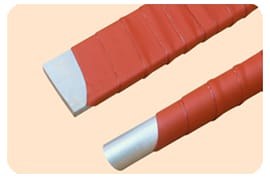
Look at the wrapped bar and the wrapped rod in the manufacturer's photograph. The turns overlap. The covering is a helix, not a tube.
A recovered sleeve gives you one continuous wall. A taped covering gives you a continuous adhesive path instead, running the whole length of the helix. That path is the whole of the water defence.
The adhesive is driven into the surface by the shrink itself, so a turn that never reached 125 degrees C is a turn that never sealed. Under a finished wrap you cannot tell which one that was. Watch the bead of melted adhesive at the edge of each turn as you go.
In a dry panel none of this matters much. The helix only becomes the weak point when the whole overlap path is loaded at once: a flooded pit, a hose-down, standing water in a kiosk.
So specify it as a rain and splash covering unless the manufacturer confirms an immersion rating in writing for your code and your wrap. That is a cheaper conversation than an excavation.
Before the roll goes on
- Heat shrink tape against electrical tapeShrink tape, mastic and non-shrinkable HV tape set side by side
- Mastic tapeThe filler that goes on before the shrink tape, where there is a step to bridge
- Building insulation by handGNT tape, half-lapped, where nothing can be heated
- How to install a wraparound heat shrink sleeveSurface preparation and torch discipline, which are the same here
- Reading a heat shrink datasheet without taking it on trustWhat ASTM D2303, ASTM D2671 and IEC 216 actually measure
- Who manufactures the sleeves indexed hereGala Thermo Shrink Pvt. Ltd., Palghar and Surat SEZ
Give the geometry and the voltage
Send the bar section, the shape being covered, the developed length to be wrapped and the system voltage. Say whether the covering will ever sit in water. Those five facts settle the quantity of GMT-2L and the answer on the IP question in one reply.