Poles
Pole protection sleeve, wrapped at the ground line
The pole came down in a storm, and the crew who walked that route last year saw nothing wrong with it.
A pole rarely fails at the top. It fails where it enters the ground.
Two things coincide there. Decay rates in the upper 20 cm of soil run roughly twenty times higher than deeper down. That band also carries the highest bending moment, because wind, ice and conductor tension all resolve at grade.
So the pole loses section where it is worked hardest, and the manufacturer is blunt about the aftermath. A pole broken in bad weather often passes an untrained eye until somebody examines the outer wood at grade. You will not catch that by looking up from the road.
Two mechanisms meet in the same 200 mm
Steel and concrete first. No pole sheet publishes a corrosion mechanism for metal, so what follows is standard corrosion engineering and not a manufacturer claim. Oxygen is plentiful in air and scarce in wet soil. Where the metal crosses that boundary the buried surface turns anodic and loses metal, while the exposed steel above stays cathodic and looks sound.
The band immediately above grade is attacked a second way. Rain and splash wet the surface, then it dries, and a coating fails at that line first. Treat both sides of grade as one repair.
Wood fails by another route, and this one the manufacturer documents properly. Water enters at the ground and wicks up the pole by capillary action, then evaporates above ground level. Wood needs a moisture content above 25 percent before it decays; dry wood does not decay. A seal works on timber because it lowers the point where moisture can enter, holding the wood above it under that threshold.
Termites use the same door. Drying and weathering crack the wood at and above the ground line, and those cracks reach the untreated core. Deeper down the moisture level stays constant and cracking is limited. Preservative also leaches out over the years, so decay conditions and termite conditions arrive together.
GPWS pole protection sleeve, with the GMW tubular alternative
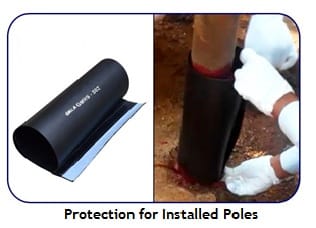
A cross-linked polyolefin band folded round a standing pole and shrunk onto it, sealing the ground line against water, decay and termite ingress. Manufactured by Gala Thermo Shrink Pvt. Ltd.
- Closes round a pole that is standing, loaded and carrying live conductors
- Hot-melt lining seals to IP 68 on the metal-pole sheet; the wooden-pole sheet claims full environmental sealing but cites no IP rating
- Resists UV, chemicals, corrosion and fungus
- Cut to length in the field to suit the exposed section
| Material | Cross-linked polyolefin |
|---|---|
| Installed poles | GPWS wraparound, folded round the pole in place |
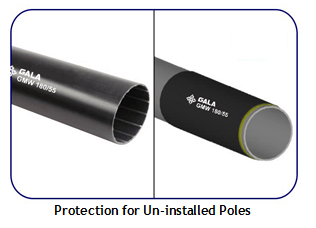
| Poles not yet set | GMW tubular sleeve, slid on before the pole goes up |
| Lining, steel and concrete | Hot-melt adhesive, environmental sealing to IP 68 |
| Lining, wooden poles | Bituminous |
| Pole OD range, GPWS | 70 mm to 360 mm across six codes |
| Supplied length, GPWS | 700 mm on every code in the chart |
| Minimum overlap, GPWS | 50 mm on GPWS-502, 75 mm on the other five |
| GMW codes on the pole sheets | GMW 180/55 to GMW 425/120 |
| Wall thickness, GMW | 3.3 mm on 180/55, 3.5 mm on the rest, plus or minus 10 percent |
| Service life | More than 30 years |
| Substrates listed | Wooden, concrete, steel and composite poles |
| Used with | Epoxy paint, on steel and concrete |
| Field cutting | Cut to size on site; custom dimensions on request |
Selection chart, installed poles
| Gala code | Pole OD (mm) | Length (mm) | Minimum overlap (mm) |
|---|---|---|---|
| GPWS-502 | 70 – 122 | 700 | 50 |
| GPWS-628 | 70 – 145 | 700 | 75 |
| GPWS-785 | 140 – 190 | 700 | 75 |
| GPWS-1005 | 150 – 250 | 700 | 75 |
| GPWS-1178 | 160 – 290 | 700 | 75 |
| GPWS-1335 | 175 – 360 | 700 | 75 |
GPWS, as published. The metal-pole and wooden-pole sheets carry these same six rows.
Selection chart, poles not yet set
| Gala code | D minimum (mm) | d maximum (mm) | Wall, ±10% (mm) | Length (mm) |
|---|---|---|---|---|
| GMW 180/55 | 180 | 55 | 3.3 | 700 |
| GMW 200/60 | 200 | 60 | 3.5 | 700 |
| GMW 250/70 | 250 | 70 | 3.5 | 700 |
| GMW 320/90 | 320 | 90 | 3.5 | 700 |
| GMW 375/110 | 375 | 110 | 3.5 | 700 |
| GMW 425/120 | 425 | 120 | 3.5 | 700 |
GMW, from the same two sheets. D is the supplied internal diameter and d the recovered internal diameter.
The wooden-pole brochure runs a second pair of charts
GPPT is the tube and GPPS the wrap. Same eight sizes and same diameters, different maximum pole diameter. Read the last two columns against each other.
| Size | D minimum (mm) | d maximum (mm) | Length per piece (mm) | GPPT tube, max pole dia (mm) | GPPS wrap, max pole dia (mm) |
|---|---|---|---|---|---|
| 115 | 115 | 36 | 1000 | 39 – 105 | 39 – 80 |
| 140 | 140 | 44 | 1000 | 47 – 130 | 47 – 105 |
| 160 | 160 | 52 | 1000 | 55 – 145 | 55 – 120 |
| 200 | 200 | 62 | 1000 | 65 – 190 | 65 – 160 |
| 250 | 250 | 73 | 1000 | 76 – 240 | 76 – 210 |
| 320 | 320 | 95 | 1000 | 98 – 310 | 98 – 280 |
| 375 | 375 | 115 | 1000 | 118 – 364 | 118 – 335 |
| 425 | 425 | 125 | 700 | 128 – 414 | 128 – 385 |
At all eight sizes the wrap reaches a smaller pole than the tube. GPPT 320 is charted to 310 mm; GPPS 320 stops at 280 mm. Size a wrap off the wrap column, never off the tube column beside it.
Sources disagree on the code system
Four pole sheets are published and they do not run one set of codes. The metal-pole and wooden-pole sheets use GPWS for installed poles and GMW for poles not yet set, over 70 to 360 mm. The wooden-pole brochure uses GPPT and GPPS instead, over 39 to 414 mm, and its own opening paragraph calls the product GWSM. Confirm which family is current before a specification names a code.
What the closure has to survive
Everything here is proven extrusion except one line down its length. The lap is where an excavated failure starts. It is 50 mm on GPWS-502 and 75 mm on the other five codes.
Read that as a floor, not a target. A pole near the bottom of its band leaves margin above the figure; one near the top leaves the figure and nothing else.
No sheet says where to index the seam around the pole, so that is judgement. Keep it off the weather side, and off the face a strimmer or a kerb can reach.
On steel and concrete the sleeve is half a system and the manufacturer says so. It is specified in combination with epoxy paint at the ground line.
If the pole is still lying in the yard, do not wrap it
A tube has no seam. That is the argument for reaching for one while the geometry still allows it. The manufacturer recommends the standard GMW tubular sleeve on fresh poles before installation.
One caution. The same GMW codes appear on the manufacturer's medium and heavy wall tubing sheets, and again on its pipe coupler sheets. This is general-purpose medium-wall tubing put to a pole.
The window shuts the day the pole is set. Wraparound or tubular settles which side of it your job sits on.
The cases the manufacturer names for fitting one
- Relocated or reused poles
- The band that was buried is not necessarily the band buried now.
- New poles set in pavement
- Water gets under a paved surface and stays, and the surface hides the band from inspection.
- Locations vulnerable to decay
- Wet ground, poor drainage, aggressive soil. The chart does not change; the case for fitting does.
- A ground line disturbed after erection
- Cable work or a change of grade has opened the soil at the base.
- Poles stored six months or more
- The pole weathered before it took load, long enough on timber for drying cracks to open.
Piles and dock posts, same problem, no published data
A timber dock pile rots in the splash zone and at the mudline for the reasons above. Wet wood, oxygen at a boundary, and a band that carries the load. The demand lands on pages like this one.
So state it plainly. No piling chart, no immersion figure and no tidal-zone result is published for these codes. The pole charts are for poles.
Where this is the wrong part
Work through these before the requisition goes in.
- A pole that has already lost section. Protection is not restoration. A sleeve seals a surface. It returns no timber, no steel and no bending capacity, and no residual strength figure is published.
- The top of the pole. A crown takes a cap, not a band, and that is a different part on a different site. We publish that one too, at anodecap.com.
- Any diameter off the charts. GPWS runs 70 mm to 360 mm; the GPPS wrap column runs 39 mm to 385 mm. Outside those, get a custom size confirmed in writing.
- A cracked concrete pole. Sealing a crack keeps water out of it. It restores no section and no cover to the reinforcement.
- A pole still on the ground. Use the tubular sleeve and avoid creating a seam at all.
- A specification that must name an electrical rating. No voltage class is published for a pole sleeve.
Not published — ask before you specify
The four pole sheets carry no property table at all. No tensile strength, no dielectric figure, and no test method printed beside any number. The manufacturer's web page for this product lists ASTM D638, D570, D2671, D792, D149, D150 and D257 for the material, with no values attached. Methods and figures therefore sit on different documents. Nothing publishes the recovery temperature, the adhesive softening point or the peel strength of either liner. The epoxy paint is named as part of the system, with no product type, film thickness or surface preparation grade.
The sequence below is ours, not the manufacturer's
No pole sheet publishes a specifying or fitting procedure. The four steps below are this site's reconstruction, built from the published selection charts. The instruction sheet supplied in the box governs the work and overrides anything here.
Specifying a pole sleeve in one email
Measure the diameter at grade
Measure where the pole enters the soil, not at chest height. Tapered poles are widest at the base and these bands are narrow.
Decide standing or lying
A pole in the ground takes the GPWS wrap. A pole in the yard takes a GMW tube, which has no seam to fail.
Read the band, do not round
GPWS-1005 covers 150 to 250 mm and GPWS-1178 covers 160 to 290 mm. A 170 mm pole sits inside three of the six bands, so give the diameter and let the manufacturer name the code.
State the coverage and the substrate
Every GPWS code is supplied at 700 mm; the wooden brochure ships 1000 mm except size 425. Say how far you will excavate and whether the pole is timber, concrete, steel or composite.
Before you raise the requisition
- Wraparound or tubularOne question decides it, and a standing pole has already answered it
- Installing a wraparound sleevePreparation and torch discipline, written once for every wrap here
- Why wraparound repairs failWhat an excavated seam looks like after it has let go
- U-bolt supports and contact corrosionThe other asset standing in place that rots at a contact nobody opens
- Test methods behind the material figures
- Manufacturer's wooden-pole sheetGPWS and GMW charts, with the bituminous liner described
Send the diameter and the substrate
Give the pole diameter at grade in millimetres, the material, whether it is standing, and how far above and below grade the band must cover. That is enough to get a code back first time.